
Slovo Building
TASAGU03
Specifications
| Diameter | 35 mm |
| Edge | smooth |
| Material | nickel |
| 🧲 | no magnetism |
| Usage | Kharkiv |
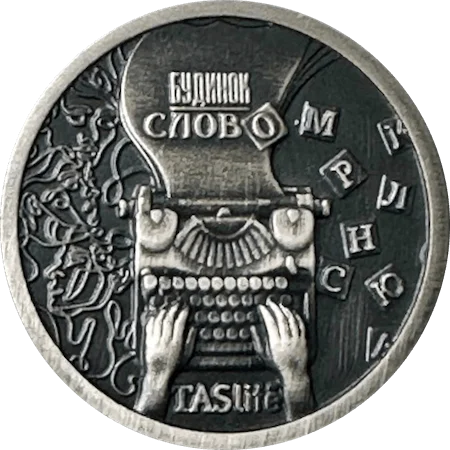
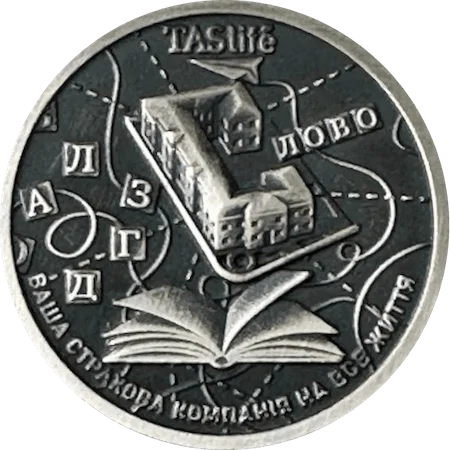
August 16, 2025. How can we explain what this house means for Ukrainian history and culture? Imagine that in one of the European capitals, Franz Kafka, Federico Garcia Lorca, Guillaume Apollinaire, Hugo Ball and Tommaso Marinetti all lived together in a house. It’s hard to imagine, isn’t it? And in Ukraine, such a house was “Slovo”. It was built at the request of Ukrainian writers and artists. After World War I, the 1917 revolution and the lost war for independence, Ukraine at that time faced poverty and a critical shortage of housing. Writers who in the 1920s determined the trends of cultural life had to huddle in the cells of publishing houses, sleep on newspapers and even store manuscripts in pots in the kitchens of cramped communal apartments. The architectural design of the building was approved in 1927: 5 entrances, 5 floors, 66 apartments. On the ground floor - a kindergarten, on the roof - a solarium. From above, the house looked like the letter "S", which is where "word" begins. Among the residents of the "Slovo" house were such writers as Mykola Khvylovy, Mike Johansen, Ostap Vyshnia, Volodymyr Yanovsky, Pavlo Tychyna, Mykhailo Yalovy, Ivan Bahryany. In addition, playwright Mykola Kulish and director Les Kurbas lived there, whose modern theater won the hearts of European audiences and stunned them with its sets at the Venice Biennale. But despite the fact that the works of these artists marked the period of the Ukrainian cultural renaissance, not many people in the world have heard of them. And there is a reason for this. Almost all of them were repressed and killed by the Soviet authorities. It was here that from 1933 to 1938, more than 70 literary residents were repressed, 11 of whom were shot in the Sandramokh tract. Later, one of the most significant periods of Ukraine's cultural revival received another name - "Shooted Renaissance". And the "Slovo" house became its symbol. Suddenly, the artistic residence became a trap for Soviet authorities for those who sought to think and create freely. The house witnessed the arrests of its residents, who were taken away in the middle of the night and put in black "funnels" of the NKVD. This was a typical Soviet scheme of repression of dissidents. For many years, the walls of the building kept the memory of those who disappeared, shot in distant Siberian tracts, murdered in camps. Only during the Stalinist terror of the "Shooted Renaissance" period, about 30,000 Ukrainian intellectuals were repressed. They knew the power of the Ukrainian Word, which the Soviet government tried to destroy by any means. In 2022, during Russia's war of aggression against Ukraine, the imperial Russian government itself apparently decided that even the walls of the Slovo building, which was damaged by enemy shelling on March 7, should become silent. As a result of the shelling, windows were broken, bricks crumbled, and a pipe was damaged. Later, in May 2024, new damage was recorded, in particular, broken windows. As of 2025, most of the damage to the building had been repaired. The Slovo building is not just an architectural structure, it is a silent witness to the talent, pain, and indomitability of Ukrainian artists. Our collector coin dedicated to this building is a symbol of the power of the Ukrainian Word, which has survived repression, war, and tyranny. It reminds us that culture is the foundation of a nation, and memory is its armor. By preserving such symbols, we do not allow history to disappear - we give it a voice in modern times. Source: Ukrainian institute https://taslife.com.ua